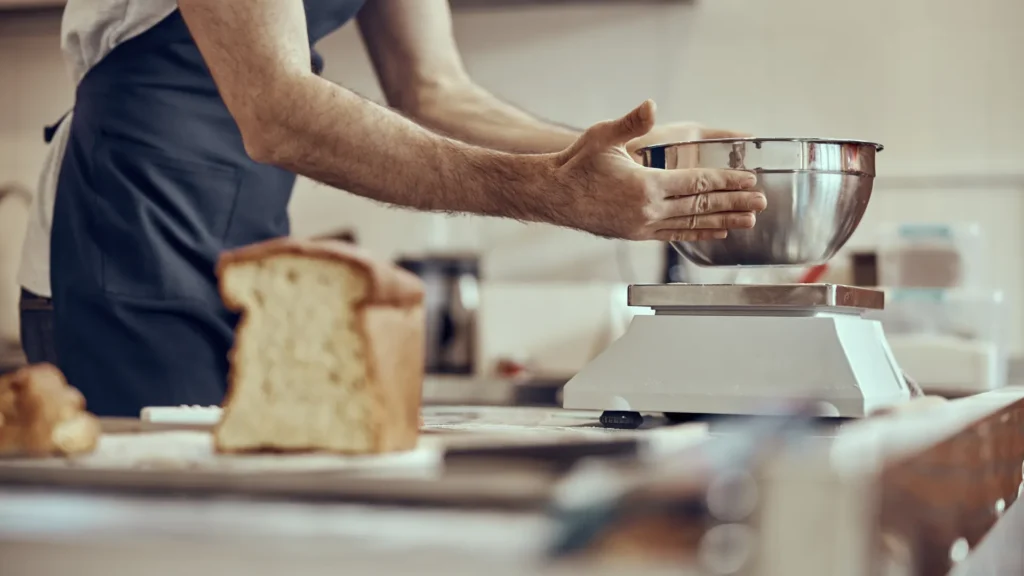

Baker’s percentages describe each ingredient by its weight relative to the total flour. The flour is 100%. Everything else is calculated from that starting point, so the percentages can add up to more than 100% without anything being wrong.
This makes a formula easier to resize. Choose a new flour weight, apply the same percentages, and you have new ingredient weights with the same ratios. You still need to decide whether the new batch fits the equipment and process.
Start with the denominator
King Arthur Baking’s baker’s-percentage reference explains the convention: divide an ingredient’s weight by the flour weight, then multiply by 100.
Ingredient percentage = ingredient weight ÷ total flour weight × 100.
Use weights in the same unit. Grams divided by grams gives a usable ratio. Grams divided by cups does not give the same kind of calculation.
For a formula using more than one flour, the denominator is the combined flour weight. King Arthur’s everyday baker’s-math guide explains how different flours contribute to that total. Keep each flour’s identity in the formula even though they share the 100% total.
Work through a small example
These three rows are an arithmetic exercise, not a complete bread recipe. There is no mixing, fermentation, or baking method attached to them.
| Ingredient | Example weight | Calculation | Baker’s percentage |
|---|---|---|---|
| Flour | 600 grams | 600 ÷ 600 × 100 | 100% |
| Water | 390 grams | 390 ÷ 600 × 100 | 65% |
| Salt | 12 grams | 12 ÷ 600 × 100 | 2% |
The percentages total 167%. That is expected because each row uses flour as its reference, rather than the total weight of all ingredients.
For comparison, the salt is 2% of the flour weight. It is not 2% of the combined 1,002 grams in the table. Using the wrong denominator changes what the number means.
Scale from a new flour weight
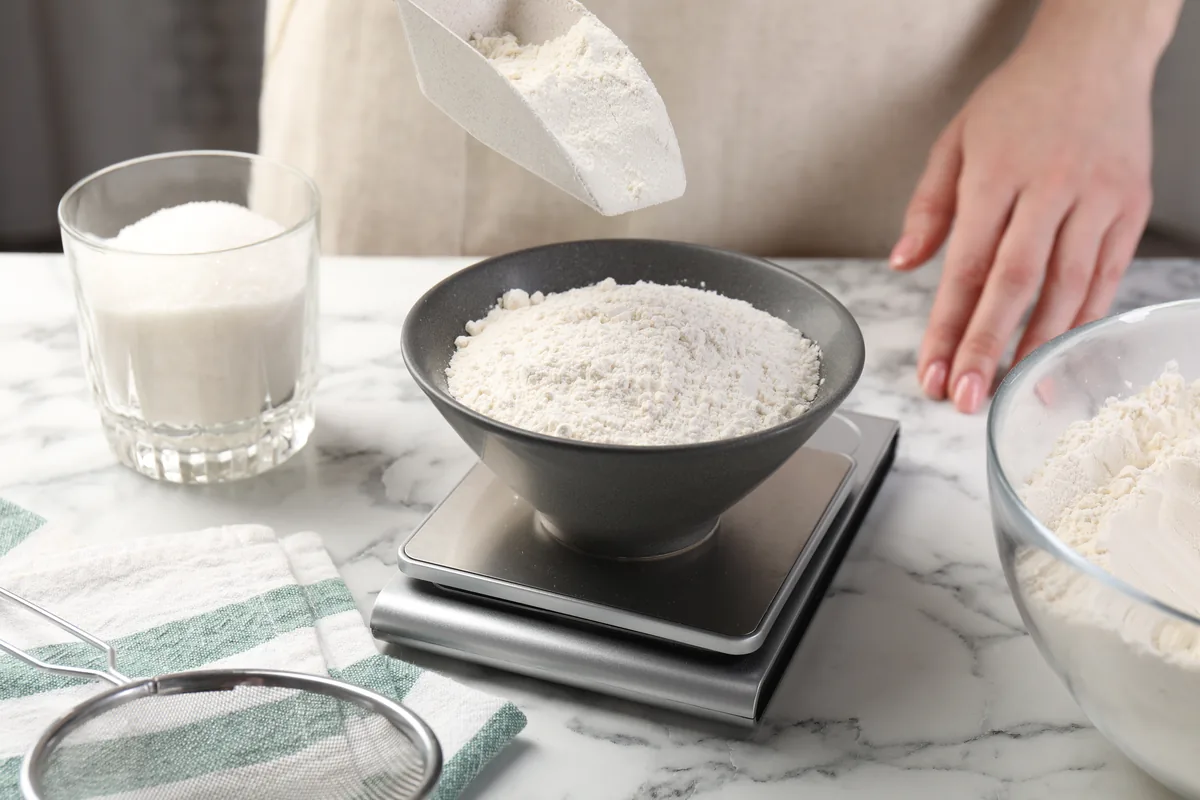
Suppose you want to repeat those ratios using 450 grams of flour. Multiply the new flour weight by each percentage expressed as a decimal:
- Water: 450 × 0.65 = 292.5 grams.
- Salt: 450 × 0.02 = 9 grams.
- Total of the three example ingredients: 450 + 292.5 + 9 = 751.5 grams.
The original flour weight was 600 grams, so the same result comes from multiplying every original weight by 450 ÷ 600, or 0.75. The percentage method and a consistent scaling factor should agree.
Write the complete new list before you start measuring. King Arthur’s recipe-reduction guide recommends doing the calculations in advance and recording the reduced amounts. That avoids having to remember which ingredient has already been resized halfway through preparation.
Work backward from a target total
A target flour weight and a target batch weight are different requests. In this exercise, flour is only one part of the total.
If you want 835 grams total while keeping these three rows at 100%, 65%, and 2%, add the percentages as decimals: 1 + 0.65 + 0.02 = 1.67. Divide the target total by that sum:
Flour weight = 835 ÷ 1.67 = 500 grams.
That gives 325 grams water and 10 grams salt, adding back to 835 grams. This works because the target total and the percentage sum describe the same complete set of ingredients. If you leave a row out of one side, the check won’t hold.
For a real formula with a starter or preferment, use a reference that accounts for the ingredients already inside it. Don’t count the same flour or water twice, and don’t assume that a starter’s entire weight is flour. The King Arthur references linked above explain total formulas and preferment accounting in more detail.
Keep the arithmetic separate from the process
The ratios can stay the same while the practical work changes. A larger batch may need a different container or exceed a mixer’s capacity. A smaller bake may need a different pan. Follow the recipe’s method and equipment requirements, and evaluate any adjustment rather than scaling the clock by the same number as the ingredients.
Small quantities need attention, too. Keep the calculated amount in your notes, then check whether your scale can measure it appropriately. Rounding several tiny quantities carelessly can change the ratios you were trying to preserve.
Before mixing, check the flour total, the units, every ingredient row, and the sum of the new weights. Save the original formula beside the resized version. Once the math is clear, you can assess the actual bake without wondering which quantity you meant to use.
Source note
This researched explanation uses the King Arthur Baking references linked above, checked October 21, 2026. The worked numbers are original arithmetic examples, not a tested recipe or a Replicate Kitchen baking result. Stock photographs illustrate weighing and recipe preparation.