
Two decisions make a Fushimi Inari visit easier to place in a Kyoto day: where you’re starting and how far you want to walk once you arrive. A short visit near the main shrine and a longer circuit on the mountain are different outings, even though both appear under the same destination name.
Choose the visit first, then leave space around it. An easy train connection doesn’t make the mountain walk a quick stop between two fixed reservations.
Start with your part of Kyoto

Kyoto City’s access guide for Fushimi Inari Taisha recommends the JR Nara Line to Inari Station from Kyoto Station. It puts that rail journey at about nine minutes, with the shrine approach immediately outside the arrival station.
From the Shijo Kawaramachi area, the same guide recommends Keihan Gion-shijo Station to Fushimi Inari Station, followed by a walk east toward the shrine. It lists about 22 minutes on the train and about five minutes for the walk, and warns that limited express trains don’t stop at Fushimi Inari Station.
These are two different arrival station names on two different railways. Save the one that matches your route. Don’t start with a journey from Kyoto Station if you’re already somewhere better served by Keihan.
The published journey times are useful comparisons, not your complete door-to-door allowance. Add the walk from your accommodation or previous stop, finding the departure, and any wait for the train. Check a current journey planner and the train’s stopping pattern before boarding.
Choose a shrine visit or a mountain outing
The shrine’s official map separates places such as the main shrine, Senbon Torii, and sites farther along the mountain routes. Use it to identify what you mean by “visiting Fushimi Inari,” rather than adopting someone else’s completion target.
For a shorter visit, make a modest plan around the main shrine area and the part of the gate-lined route you want to see, then turn back while it still fits your day. This isn’t a promise of a set walking time or a step-free route. Check the actual paths and your own access needs before committing to a particular section.
For a longer outing, the Japan National Tourism Organization suggests about two to three hours to tour the mountain. Treat that as a planning estimate, with your pace, stops, conditions, and return journey still to consider. It isn’t time to subtract from an afternoon without also accounting for getting there and back.
You don’t need to make the longer walk the measure of a successful visit. If your aim is the shrine and a shorter section of the route, let that be the plan. If the mountain walk is the reason you’re going, give it a clear block in the day instead of squeezing it around another attraction.
Keep the calendar with the route
Fushimi Inari Taisha is an active place of worship. Its events calendar includes ceremonies throughout the year, including New Year’s Day and December 31. Check the calendar and current notices for the date you’re considering, particularly around a holiday visit.
Don’t translate an empty stock photograph or an early departure into a guarantee about crowds. The useful preparation is knowing your route, allowing flexibility, and following the arrangements you find on arrival.
For a day with another booking, decide in advance what you’ll shorten if needed. A flexible lunch or a shorter walk is easier to change than the departure time on an onward ticket. Keep that choice with your route notes so it doesn’t become a debate halfway through the visit.
Let worshippers pass
Read the shrine’s requests to visitors before going. They prohibit obstructing worshippers while photographing narrow paths, entering restricted areas, flying drones, and photography for commercial purposes or in prohibited areas. Eating and drinking are restricted to marked areas, rather than while walking or standing elsewhere on the grounds.
For an ordinary visitor, the practical point is simple: keep movement and worship ahead of a photograph. Follow signs and staff instructions, and don’t treat a clear stretch of path as a space you can hold for a picture.
Before leaving, save your route back from the station you’ll actually use. It may make sense to return a different way if the rest of the day is in another part of Kyoto. Compare that journey on its own rather than automatically retracing the morning’s route.
Sources and photographs
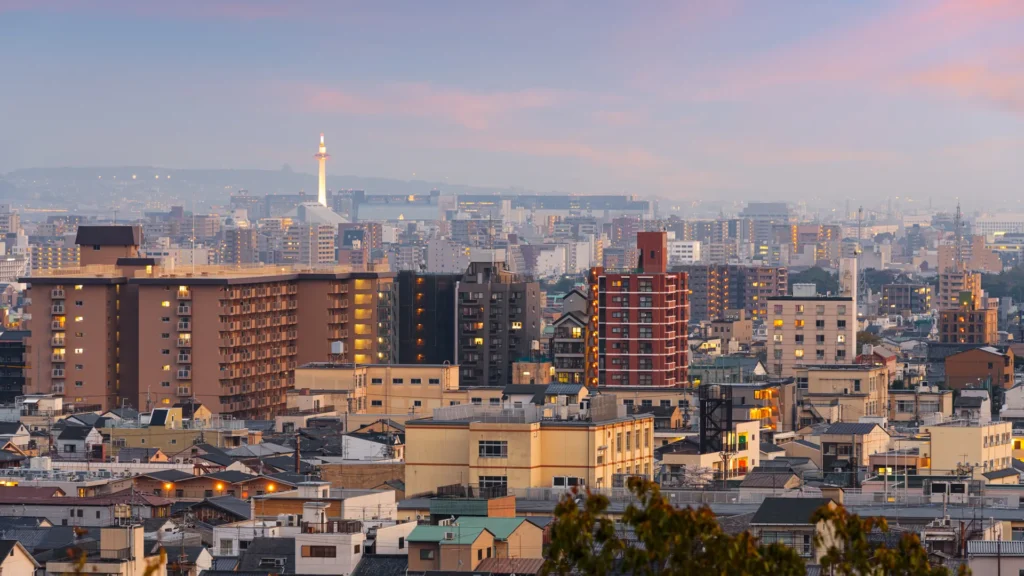
Kyoto City, Japan National Tourism Organization, and shrine references checked October 22, 2026. Journey and walking times are attributed planning estimates, not Replicate trip measurements. Licensed stock photographs show the Kyoto city skyline and Kyoto Station exterior; neither photograph shows Fushimi Inari Taisha or a view from its mountain paths.
Found an error or an outdated detail? Send a correction for this article.