
Decide what you want to do on Bainbridge Island before deciding whether to take a car on the ferry. A visit centered near the terminal may work well on foot. A day spread across the island needs a transportation plan, whether that’s your vehicle or a confirmed connection after arrival.
Compare the complete outing: how you’ll reach the Seattle terminal, what you’ll pay in each direction, how you’ll move around Bainbridge, and when you need to return. Having a car available in Seattle doesn’t by itself make bringing it the better choice.
Start with the island stops
The Bainbridge Island Museum of Art describes itself as a five-minute walk from the ferry terminal and offers free museum admission, with some special events ticketed separately. That’s a concrete example of a visit you can examine without assuming you need a vehicle on the island. Check its current hours and the walking route for your party.
Bloedel Reserve’s directions describe a different journey: the Reserve is about six miles from the Winslow ferry terminal. Its page lists transit options as well as driving directions. Check those connections for your actual day and allow for reaching the entrance and returning to the ferry. Don’t assume either that every island stop is a short walk or that bringing a car is the only possible solution.
Put your intended stops on a map, including any admission times. If the day is mainly about the ferry crossing and a compact visit near the terminal, assess that version before adding a car and a longer island itinerary.
Compare both directions of the fare
WSDOT’s ticket information distinguishes passenger fares from vehicle-and-driver fares. On the Seattle/Bainbridge route, passenger tickets cover roundtrip travel; vehicle-and-driver travel is charged one way. Other passengers in the car need their passenger fares considered separately.
That means comparing a single passenger fare with one vehicle fare won’t describe two complete outings. Use the official fare calculator for the route, date, travelers, and vehicle category, then build the whole comparison.
| Cost to check | Walk-on plan | Drive-on plan |
|---|---|---|
| Ferry travel | Applicable passenger fares for the group. | Vehicle-and-driver fares in both directions, plus applicable fares for the other passengers. |
| Reaching the terminal | Transit, a ride, or parking if leaving a car in Seattle. | Travel to the vehicle queue and any associated driving costs. |
| Moving around Bainbridge | Any bus, arranged ride, or other transportation the itinerary needs. | Driving costs and parking for the actual stops. |
Vehicle fares depend on dimensions. WSDOT’s ticket page explains the categories; check the vehicle you’re taking, including anything attached or towed, rather than selecting a category from memory. Include applicable payment fees and any seasonal pricing shown for the travel date.
If a rental car is involved, count the rental cost according to the booking you actually have. Walking aboard doesn’t automatically remove a rental day you’ve already committed to. The partial-trip car rental guide covers that separate decision.
A ticket and a place in the vehicle line are different things
The WSDOT first-time rider guide lists vehicle reservations for Anacortes/San Juan Islands and Port Townsend/Coupeville. Seattle/Bainbridge is not among those listed routes. Don’t treat an advance fare purchase as a reserved vehicle space on your preferred sailing.
WSDOT’s best-times guidance is a forecast for vehicle traffic, based on past ridership and planned vessel capacity. It says there is room for walk-on passengers and bicycles in almost all cases. That makes the mode distinction useful, but it isn’t a guarantee for a particular crossing.
Check the current schedule and service information before leaving. Assess the return direction too, especially if you have a dinner booking, flight, or another fixed commitment after reaching Seattle. A plan with room for another sailing is different from one that depends on boarding a single departure.
Allow time to be aboard
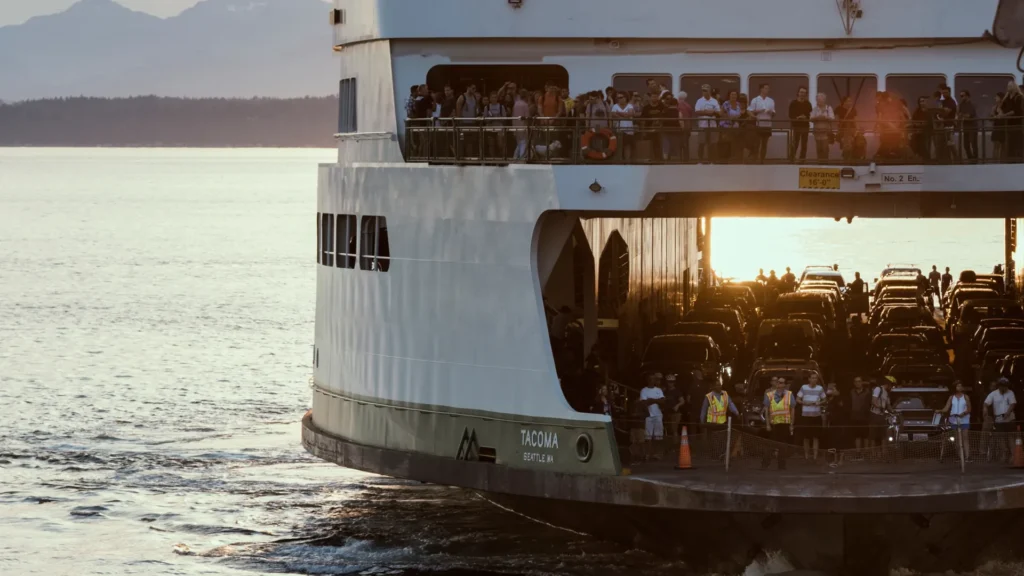
WSDOT tells walk-on riders to plan to be aboard at least five minutes before sailing. That’s a boarding target, not a suggestion to arrive at the terminal five minutes before departure. You still need time to reach the entrance, obtain or present the appropriate ticket, and follow the boarding process.
For vehicles, its general guidance is to be in the tollbooth line at least 20 minutes before sailing on most routes. That is guidance for arriving in line, not a promise that 20 minutes secures space. Follow current terminal information and crew directions.
BIMA describes the ferry crossing itself as 35 minutes. Build the itinerary around more than that water time: terminal access, waiting, loading, unloading, and the journey to the first island stop also belong in the day.
Before choosing the mode, write down the first island destination, the return plan, and the complete fare comparison. Then choose the transport that supports that day. Adding a vehicle should solve a real part of the itinerary, rather than become a habit carried over from the rest of the trip.
References
WSDOT ticket, first-time rider, and vehicle-traffic guidance, plus BIMA and Bloedel Reserve visitor information, checked October 21, 2026. The guidance describes that source check, not historical fares or schedules on the archive date. This is a researched planning guide, not a host ferry trip report. Stock photographs illustrate Seattle and ferry travel without documenting a particular sailing taken by the hosts.
Found an error or an outdated detail? Send a correction for this article.